
Picture this scene: you are standing in the party aisle of a big box store, fluorescent lights humming overhead, scanning rows of plates, napkins, and banners. There are five faces staring back at you. The same five faces that stared back last year, and the year before that. A superhero. A princess. A talking car. A cartoon mouse. A blue dog. Your child, meanwhile, is at home announcing, with the absolute conviction only a five-year-old can muster, that this year's birthday party will be "Space-Dinosaurs Who Drive Construction Trucks." Not space. Not dinosaurs. Not construction. All three. At once. With a side of sharks wearing tutus, because obviously.
For a moment, you feel that familiar squeeze of parental panic. There is no aisle for that. There is no themed pack of paper plates featuring a velociraptor operating a cement mixer on Mars. You start mentally drafting a Pinterest board, calculating how many evenings you will spend cutting felt shapes after bedtime, and wondering if maybe, just maybe, you can convince your child that a regular dinosaur party is "basically the same thing." (It is not. They will know.)
Here is the good news, and the reason this article exists: in 2026, parents no longer have to settle for whatever the licensing companies decided to push this season. The era of hyper-customization has quietly arrived, and it has changed what is possible when celebrating a child's specific, glorious, deeply weird interests. You can now act as the Creative Director of your child's birthday, taking the sentence they blurted out at breakfast and turning it into a tangible, beautifully crafted centerpiece. No late-night crafting. No compromise. No "close enough."
In this article, we will look at why children's brains gravitate toward these unexpected mashups in the first place, why DIY-ing the impossible theme leads to burnout, and how a single full-custom puzzle can anchor an entire niche celebration. We will also walk through exactly how a sentence becomes a finished, cinematic image, and we will give you a practical guide for writing the perfect order brief so that the result matches the vision in your child's head. Because when a child sees their oddly specific dream rendered with care, something extraordinary happens. They feel seen.
The Psychology of the Mashup: Why Kids Love Combining the Uncombinable
Before we talk solutions, it helps to understand why your child is requesting a "Mermaid-Scientist who runs a bakery on the moon" theme in the first place. Far from being a quirky moment of indecision, this kind of mashup thinking is a window into how a healthy young mind organizes the world.
Between the ages of three and six, children are in the thick of what early childhood researchers call combinatorial play. They are not just absorbing categories (dinosaurs are reptiles, mermaids live in water, scientists wear coats). They are actively testing what happens when those categories collide. This is the same cognitive mechanism that, in adulthood, fuels innovation, humor, and creative problem-solving. The child who insists on a Shark-in-a-Tutu is rehearsing the exact mental flexibility that engineers, writers, and designers rely on for the rest of their lives.
Mashups as identity exploration
There is also something deeper going on. When your child mashes up interests, they are often trying to fit several pieces of their own emerging identity into one picture. They love ballet. They also love sharks. Telling them to pick one feels, from their perspective, like being asked to amputate part of themselves. The mashup is not indecision. It is integration.
Why "off-the-shelf" themes can feel deflating
This is why a generic licensed party can sometimes land with a quiet thud, even when the child claimed to like that character. The theme reflects a packaged version of an interest, not the personal, layered version living inside their imagination. A child who is obsessed with "space and dinosaurs and the color teal" does not see themselves in a plain dinosaur banner. They see a flattened, polite version of who they are.
- Cognitive flexibility: Combining unlike ideas builds the neural pathways that support creative thinking later in life.
- Narrative ownership: A unique theme gives the child a story they invented, not one handed to them.
- Emotional validation: Honoring a weird interest tells the child their inner world is worth taking seriously.
- Social confidence: Kids who see their specific passions celebrated tend to share those passions more openly with peers.
The DIY Burnout: Why Pinterest Is Not the Answer
Once a parent accepts that the licensed aisle will not deliver, the next instinct is usually to DIY. This is where the trouble starts. The fantasy is beautiful: a hand-painted backdrop, custom cookies shaped like astronaut dinosaurs, themed party favors assembled with love. The reality, for most working parents, is three weeks of mounting stress, a credit card bill that quietly doubles, and a kitchen table covered in glitter that will outlive us all.
The "Pinterest tax" is real, and it falls heaviest on parents who already feel pressure to perform their parenting in visible, photographable ways. You start with one craft and end up project-managing an entire event design firm out of your living room, often while also being the host, the photographer, and the emotional support human for a very excited birthday child.
The hidden cost of doing it all yourself
- Time: Niche themes require sourcing, prototyping, and assembly that can eat dozens of evening hours.
- Money: Specialty craft supplies often cost more, in total, than commissioning a single high-quality custom piece.
- Emotional bandwidth: The pressure to deliver a magical day can crowd out the actual joy of celebrating with your child.
- Quality risk: Even with the best intentions, late-night crafting rarely matches the polish of the original vision.
The "instant centerpiece" approach
Here is a different mental model. Instead of trying to recreate the entire imagined universe across every surface of the party, choose one anchor object. One thing that captures the whole theme in a single, beautiful image. A full-custom puzzle plays this role unusually well. It is a hero piece you can display on the gift table, hand to the birthday child as a centerpiece, and then keep forever as a real, framed memento of that specific year and that specific obsession. Everything else (plates, napkins, decor) can be simple and color-coordinated to the puzzle. The puzzle does the heavy lifting. You do not have to.
This shift, from "produce a whole themed universe" to "commission one perfect anchor," is what saves the weekend. It also tends to produce a more elegant party, because the eye has somewhere specific to land instead of being pulled across a dozen competing DIY elements.
From Prompt to Masterpiece: How a Sentence Becomes a Scene
The question parents ask us most often is some version of: "But how does that actually work? I have a sentence in my head. How does it become a real picture?" It is a fair question. A few years ago, the answer would have involved hiring an illustrator, exchanging weeks of emails, and paying a four-figure invoice. Today, the workflow is dramatically different, and the results are arguably better.
Step one: the prompt
It starts with a sentence from you. "My daughter as a marine biologist mermaid examining a glowing jellyfish at the bottom of the ocean, with her cat Pickles floating beside her in a tiny diving helmet." That sentence, weird as it may sound out loud, is the seed. Our team treats it as a creative brief, the same way a film director treats a screenplay.
Step two: visualization
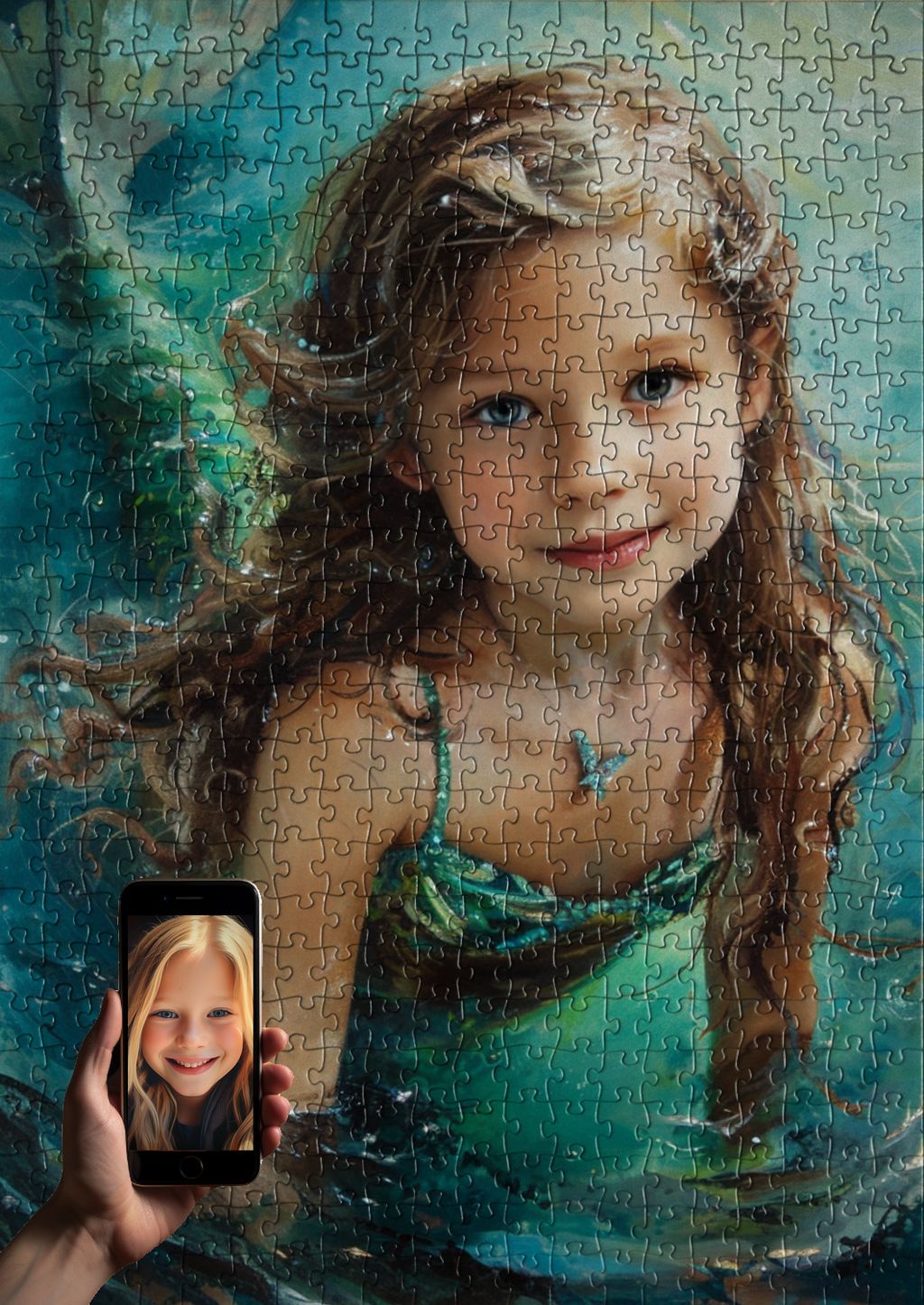
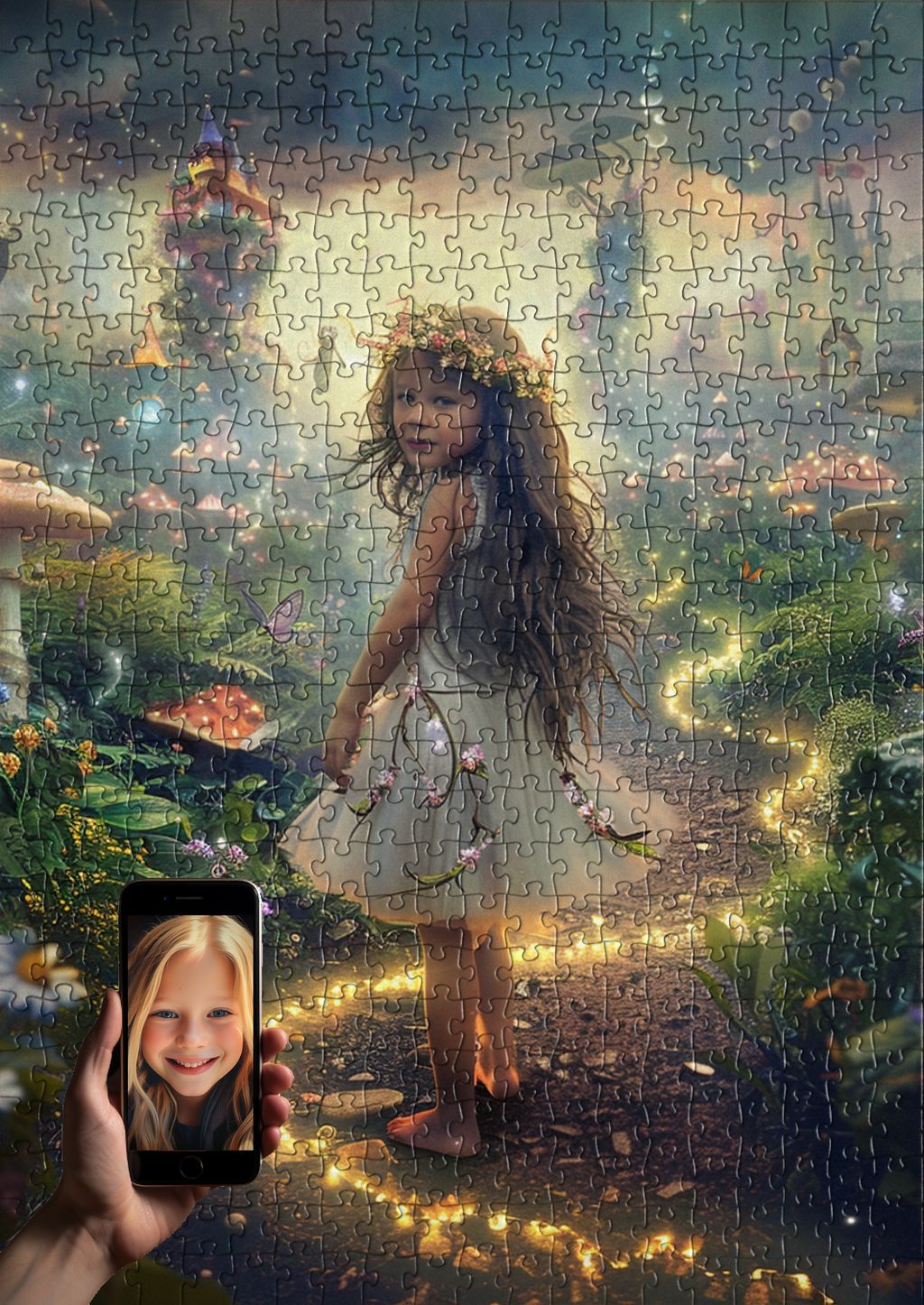
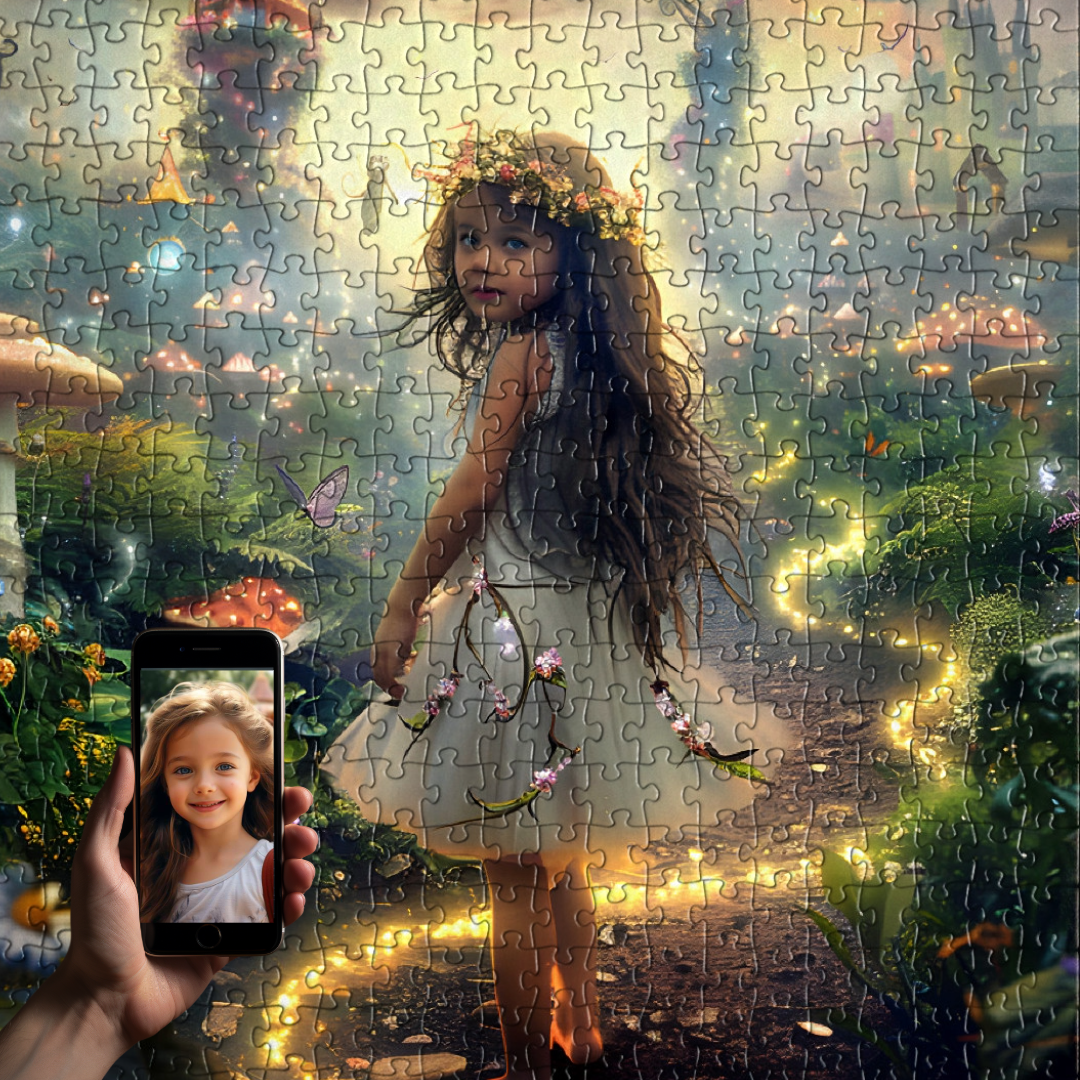
From there, our digital artists use professional visualization tools to translate the words into a high-fidelity scene. This is not "type and pray." It is a guided process where artists shape lighting, composition, character expression, color palette, and atmosphere to match what a thoughtful illustrator would deliver. The child's face, if you have provided a reference photo, is then carefully integrated so that the hero of the scene is unmistakably them.
Step three: the puzzle
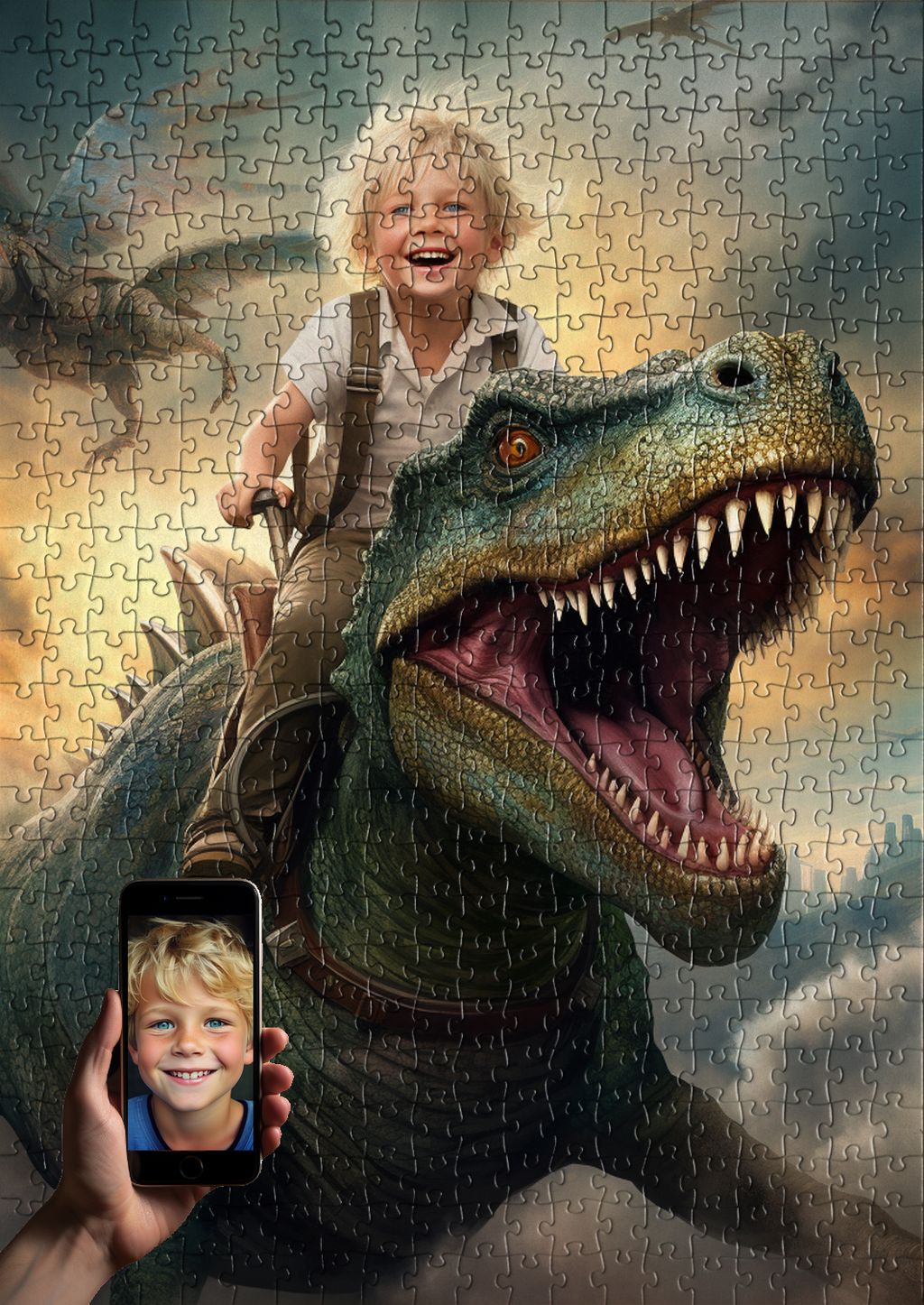
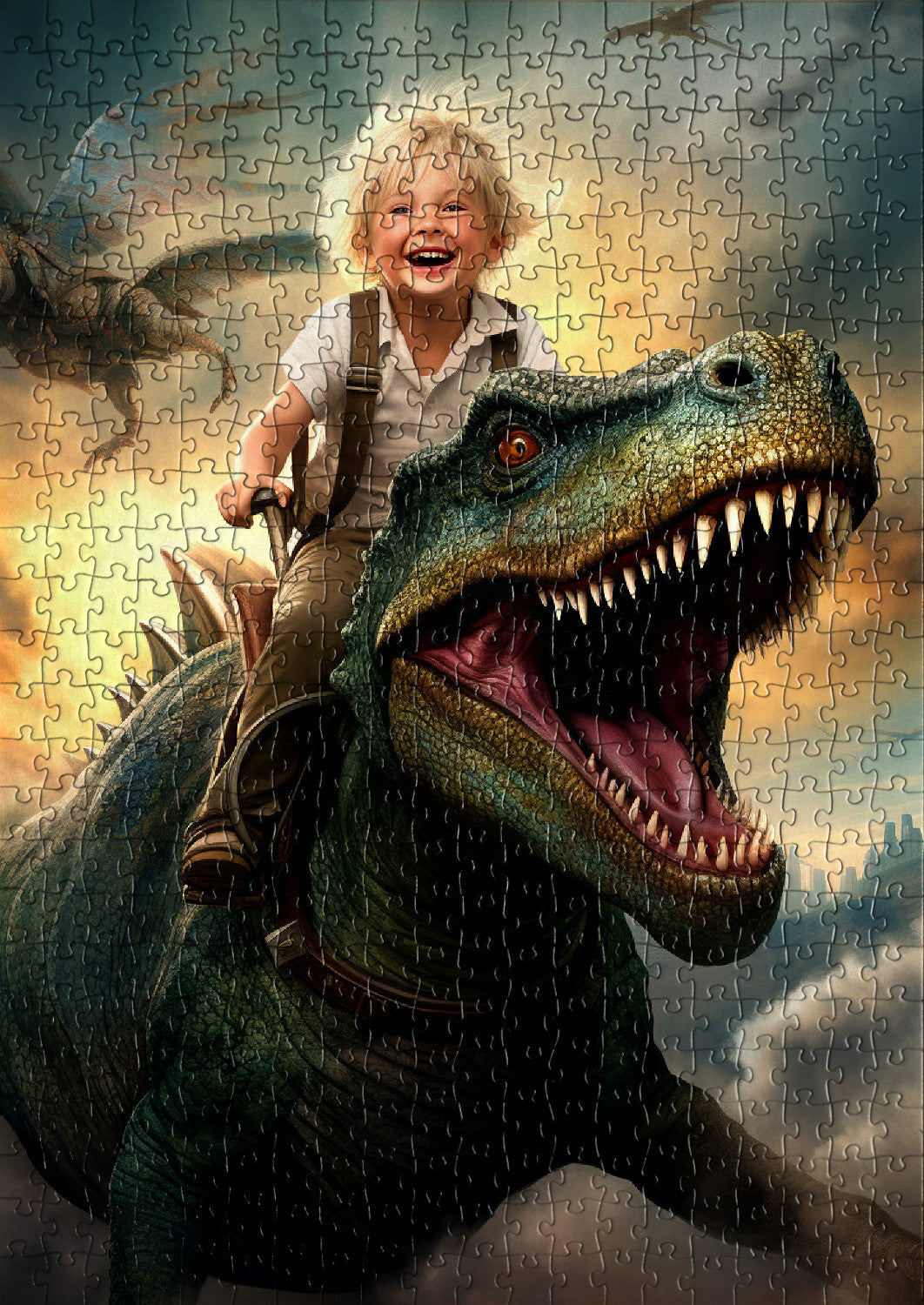
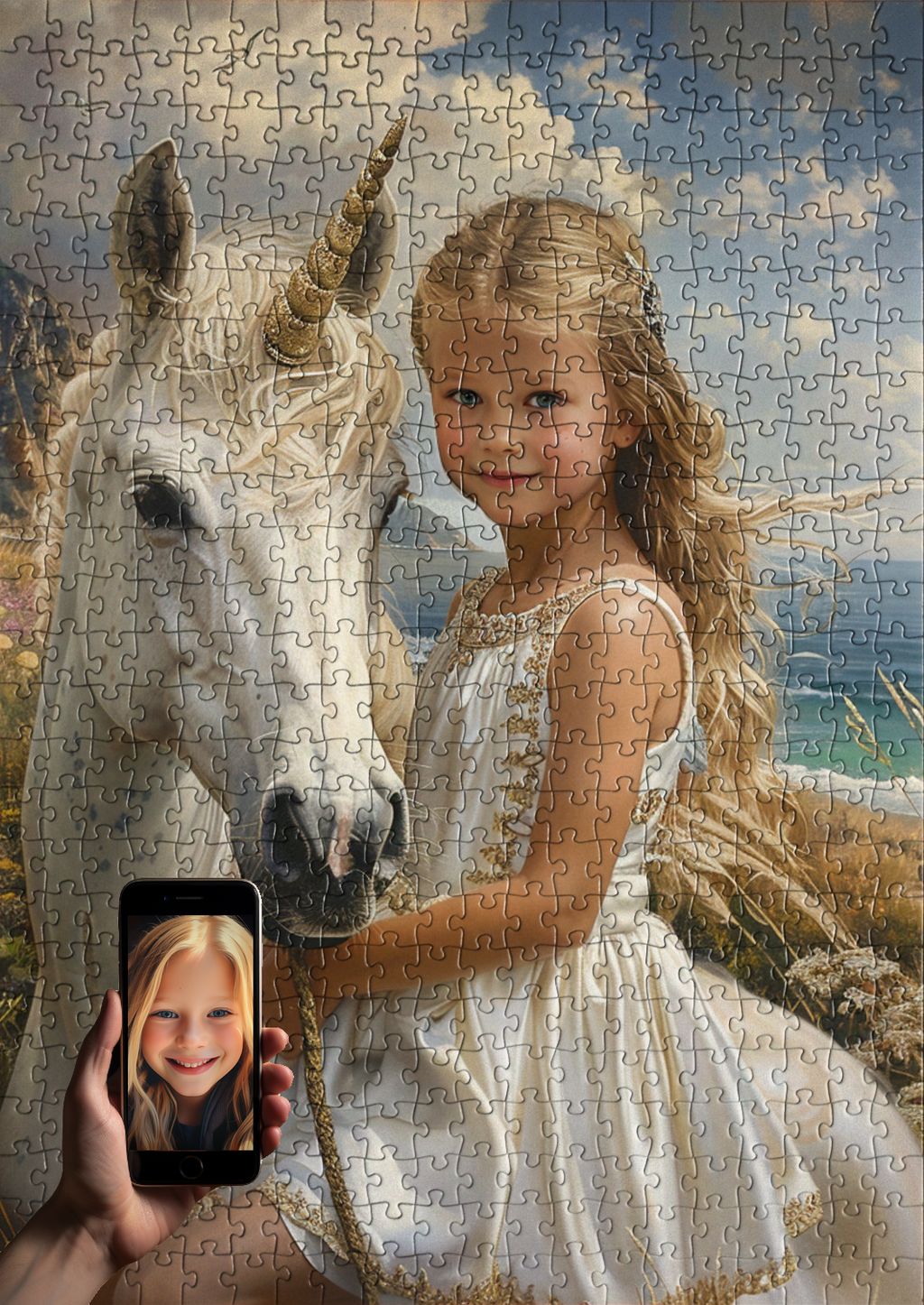
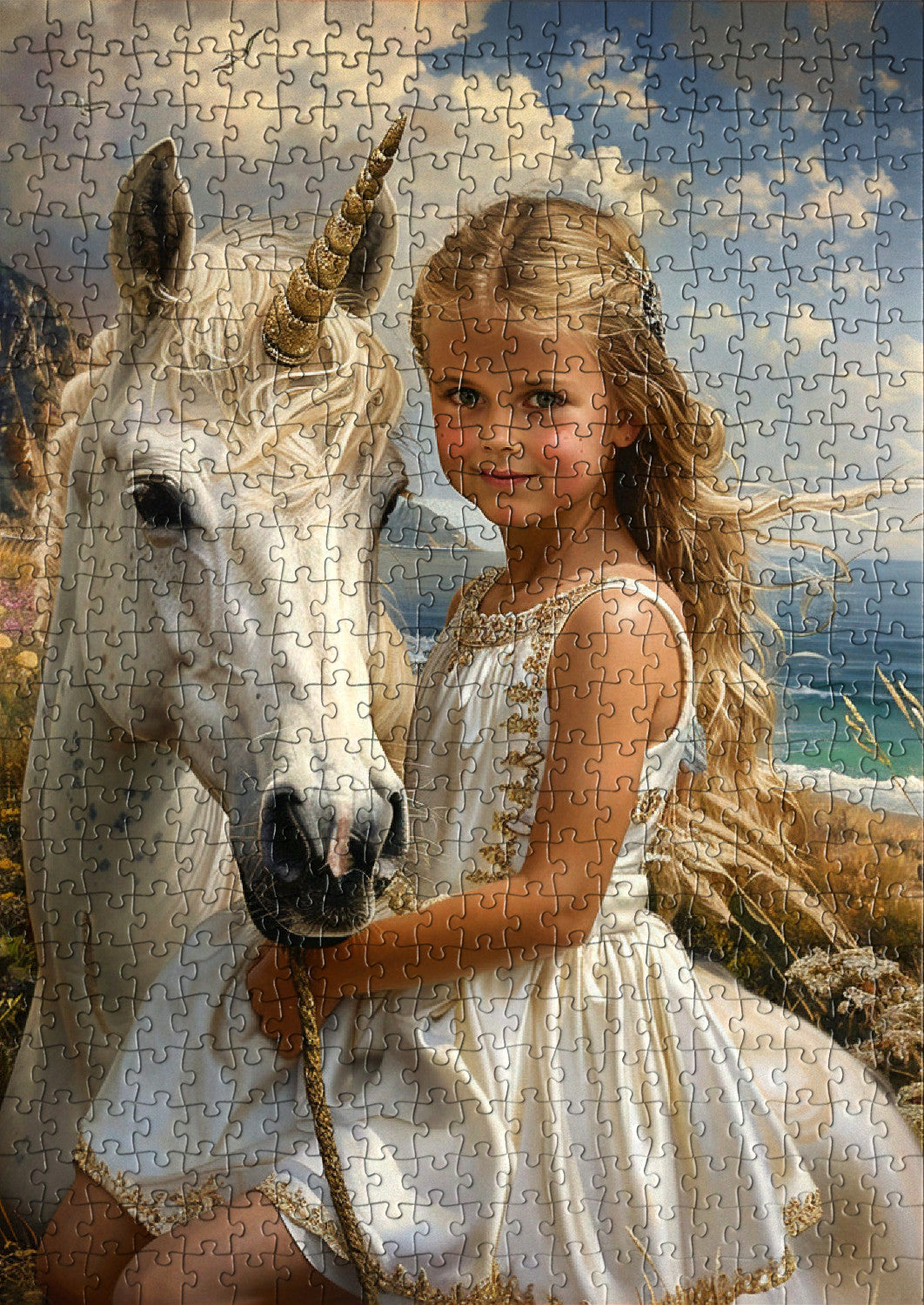
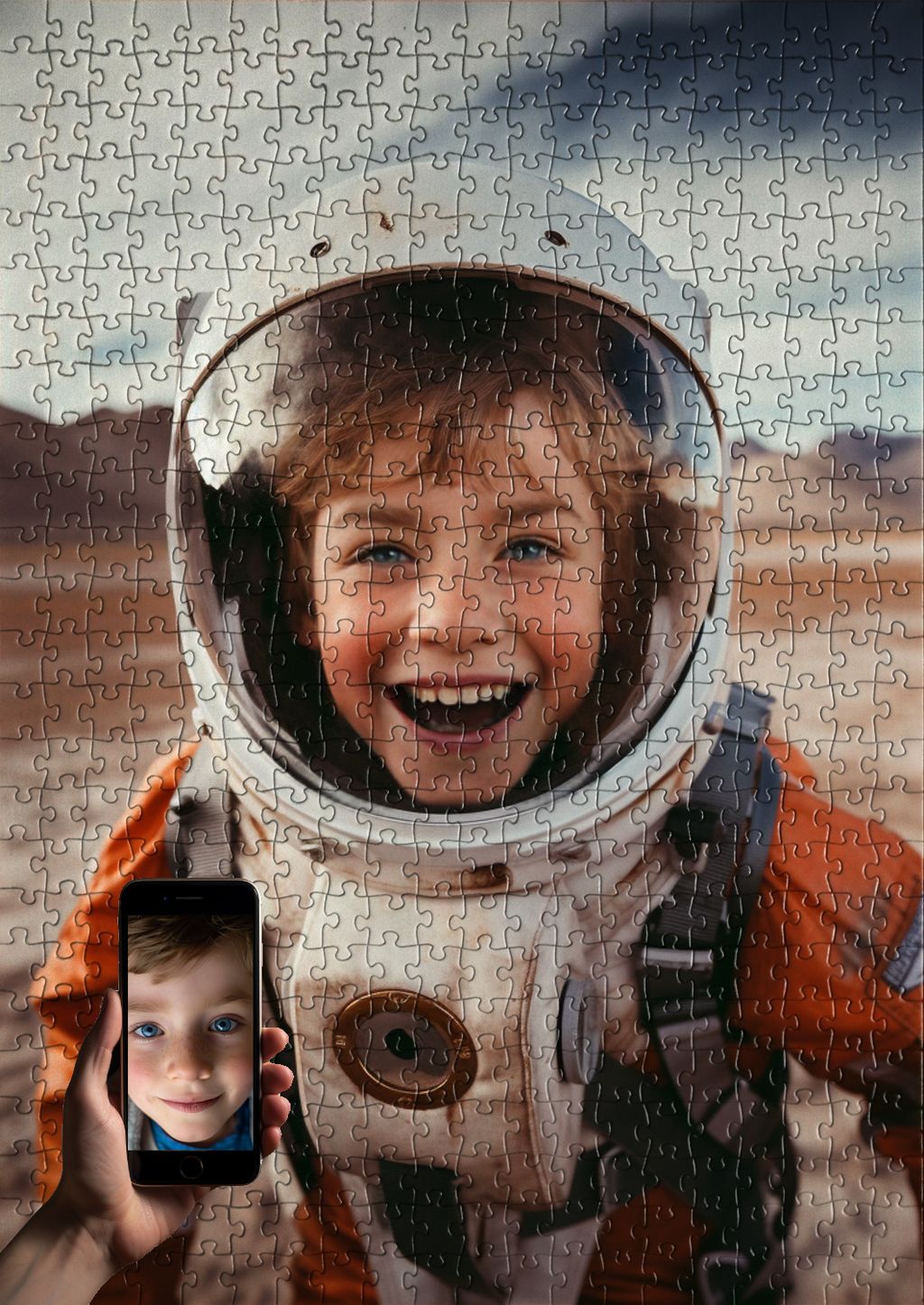
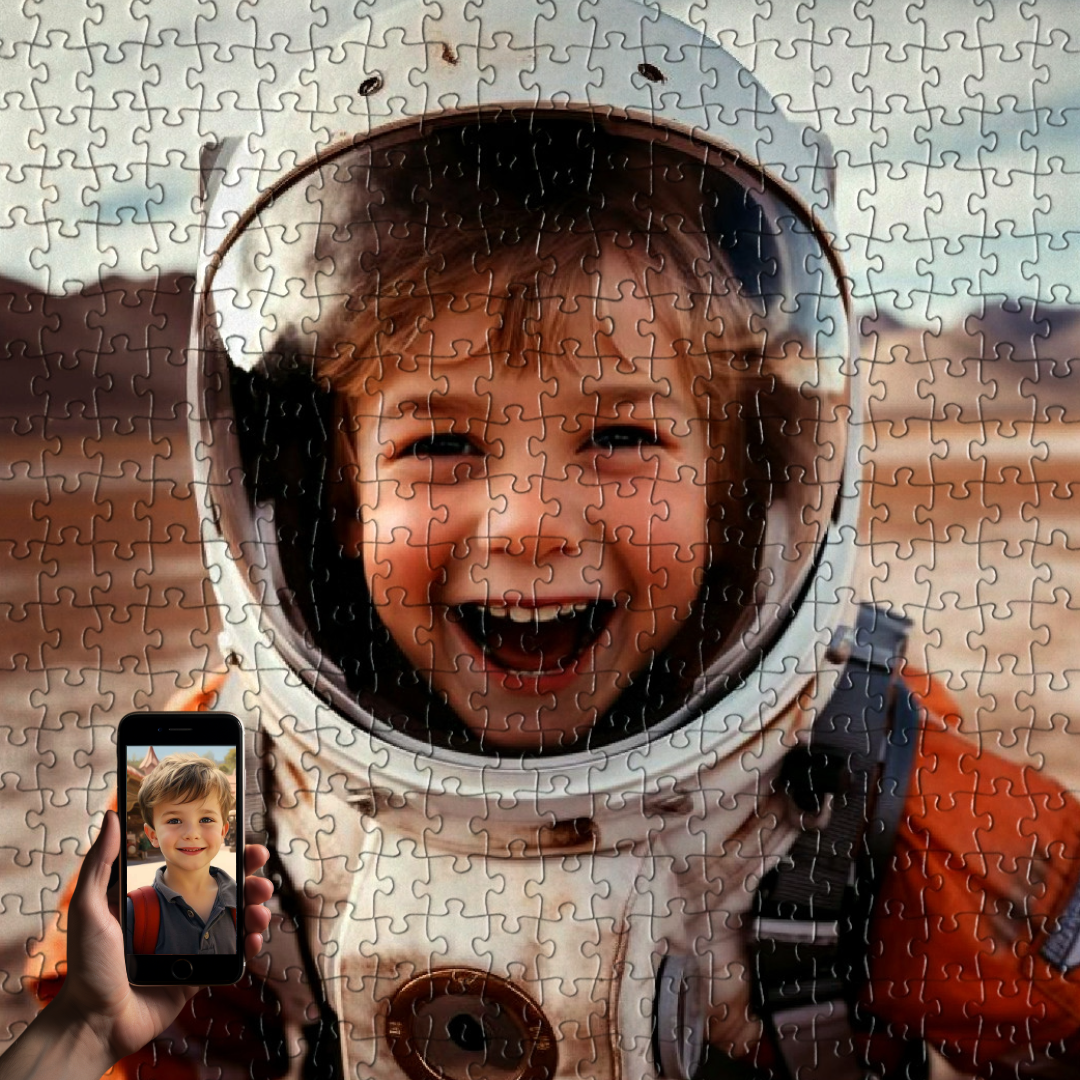
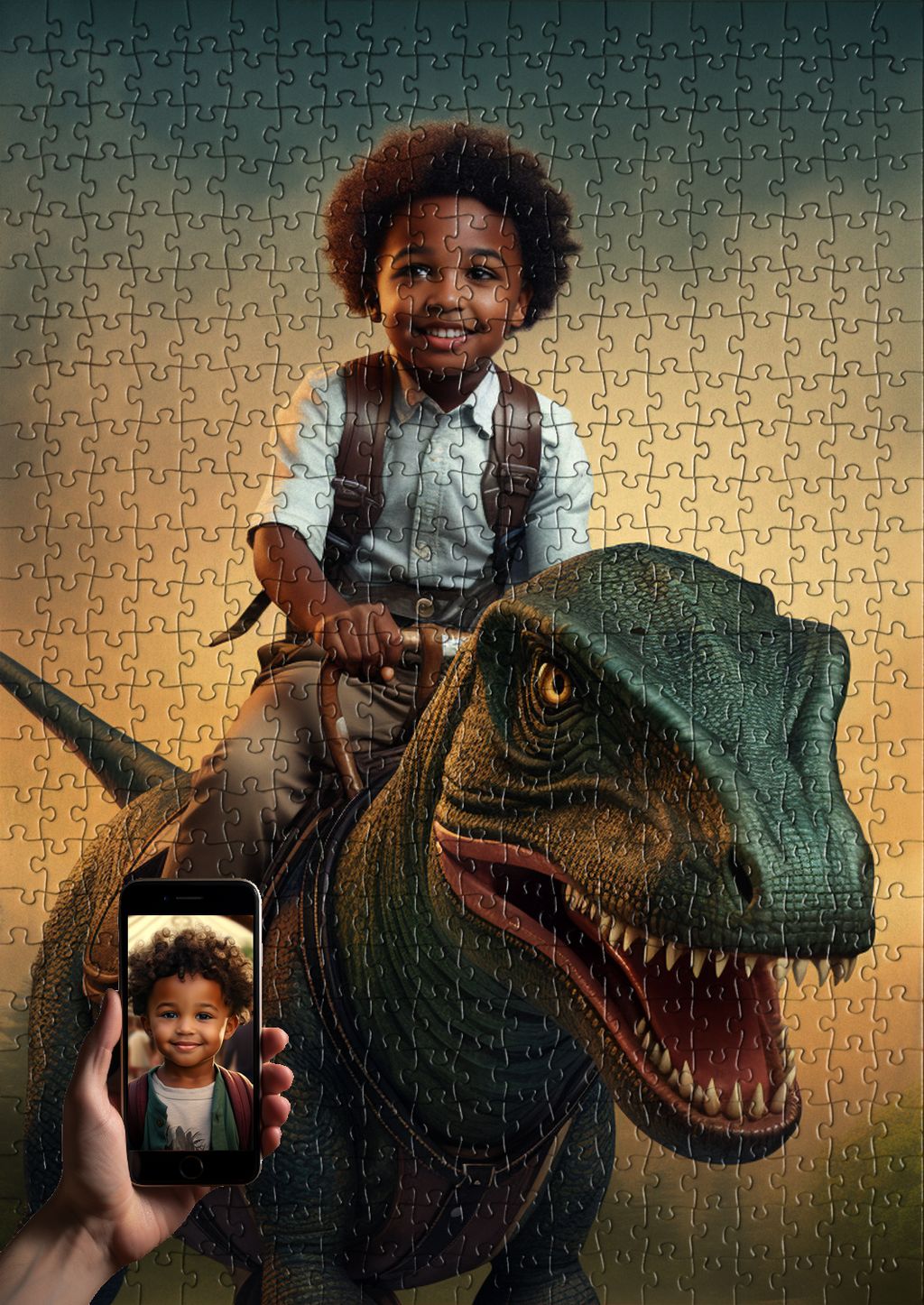
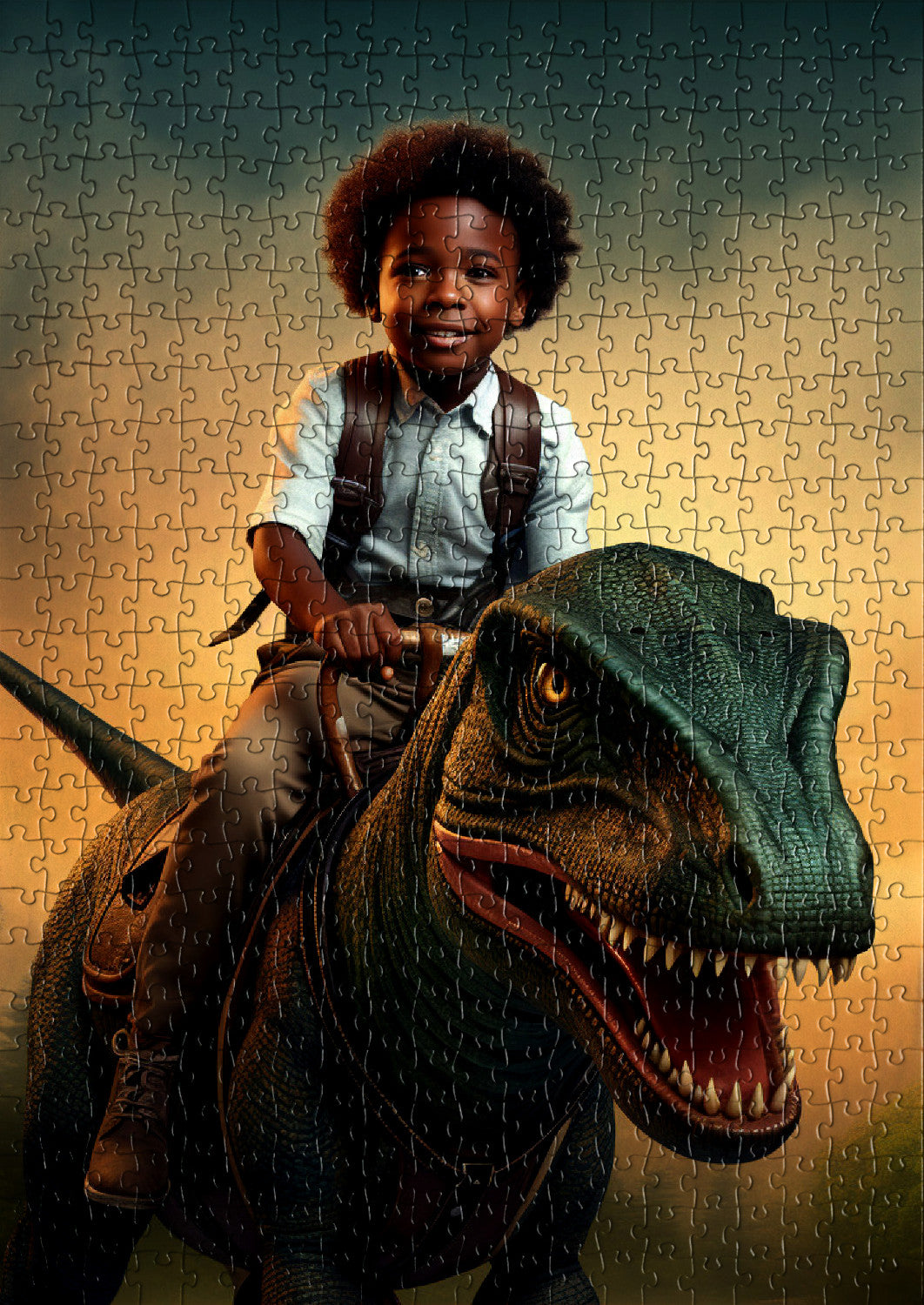
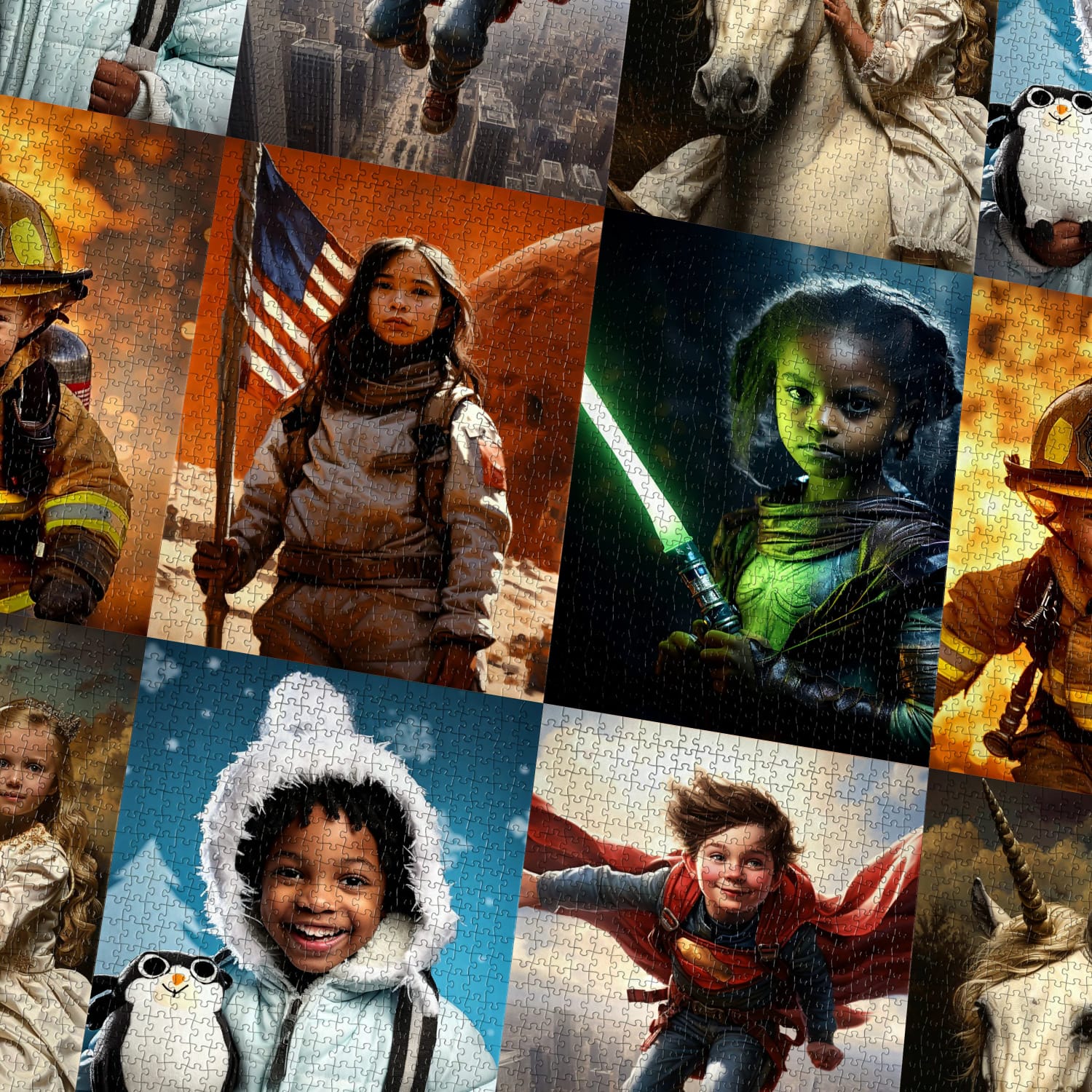
Once the image is finalized, it is printed on premium puzzle stock, cut to size, and packaged. What arrives at your door is not a digital file. It is a tangible, holdable, piece-by-piece artifact your child can assemble, display, and revisit. Pieces like Kid Riding Dinosaur and Astronaut Kid give a sense of the visual style: cinematic, warm, and clearly built around the child as the protagonist.
What makes the result feel "cinematic"
- Lighting direction: Soft, directional light gives the scene depth and a movie-still quality rather than a flat sticker look.
- Environmental storytelling: Background details (a half-eaten space snack, a tiny robot sidekick, a glowing reef) make the world feel lived-in.
- Character agency: The child is shown doing something, not just standing there. Action makes the image feel like a moment, not a portrait.
- Texture and finish: A painterly finish (rather than cartoon flatness) reads as art the child can grow into.
The Gift as an Identity Anchor
There is a particular look that crosses a child's face when they receive a gift that captures their exact current obsession. It is not just delight. It is something closer to recognition. The child realizes, often for the first time in their short life, that someone was paying attention to the specific contents of their inner world, not just the general category of "kid."
Child psychologists describe this as mirroring, the experience of having one's inner reality reflected back accurately by a trusted adult. When mirroring happens well and often, children develop a stable sense of self. They learn that their interests matter, that their imagination has worth, and that the people who love them are willing to meet them where they are.
Why a hyper-custom gift mirrors so powerfully
Most gifts mirror a child only at the category level. A dinosaur toy says, "I know you like dinosaurs." A hyper-custom puzzle, by contrast, says: "I know you like the T-Rex specifically, I know you like the color teal, I know you have been pretending you live in a volcano, and I see all of it." That level of specificity does something a generic gift simply cannot. It anchors identity.
The long shelf life of being seen
Parents often tell us, weeks or months after a birthday, that the puzzle is still being talked about. It gets reassembled. It gets shown to visitors. It gets pointed at from across the room. The reason is not the puzzle itself. It is the feeling the child associates with it: this is the thing that proved my family really got me. That feeling does not fade quickly.
- Specificity beats scale: One precisely tailored gift outperforms a pile of generic ones, every time.
- The child becomes the protagonist: Being literally pictured as the hero of an adventure shifts how a child imagines themselves.
- Memory hooks: Visual artifacts tied to a specific age and interest become powerful nostalgia objects later in life.
The SwappyPrint Edge: If You Can Describe It, We Can Build It
The promise we work hardest to keep is a simple one: anything is possible. The family cat riding a dragon? Yes. Your child as the captain of a galactic library staffed by penguins? Yes. A "Mermaid-Scientist" with full lab equipment under the sea? Yes. A "Space-Dinosaur-Construction" foreman directing a crane on the surface of Jupiter? Also yes.
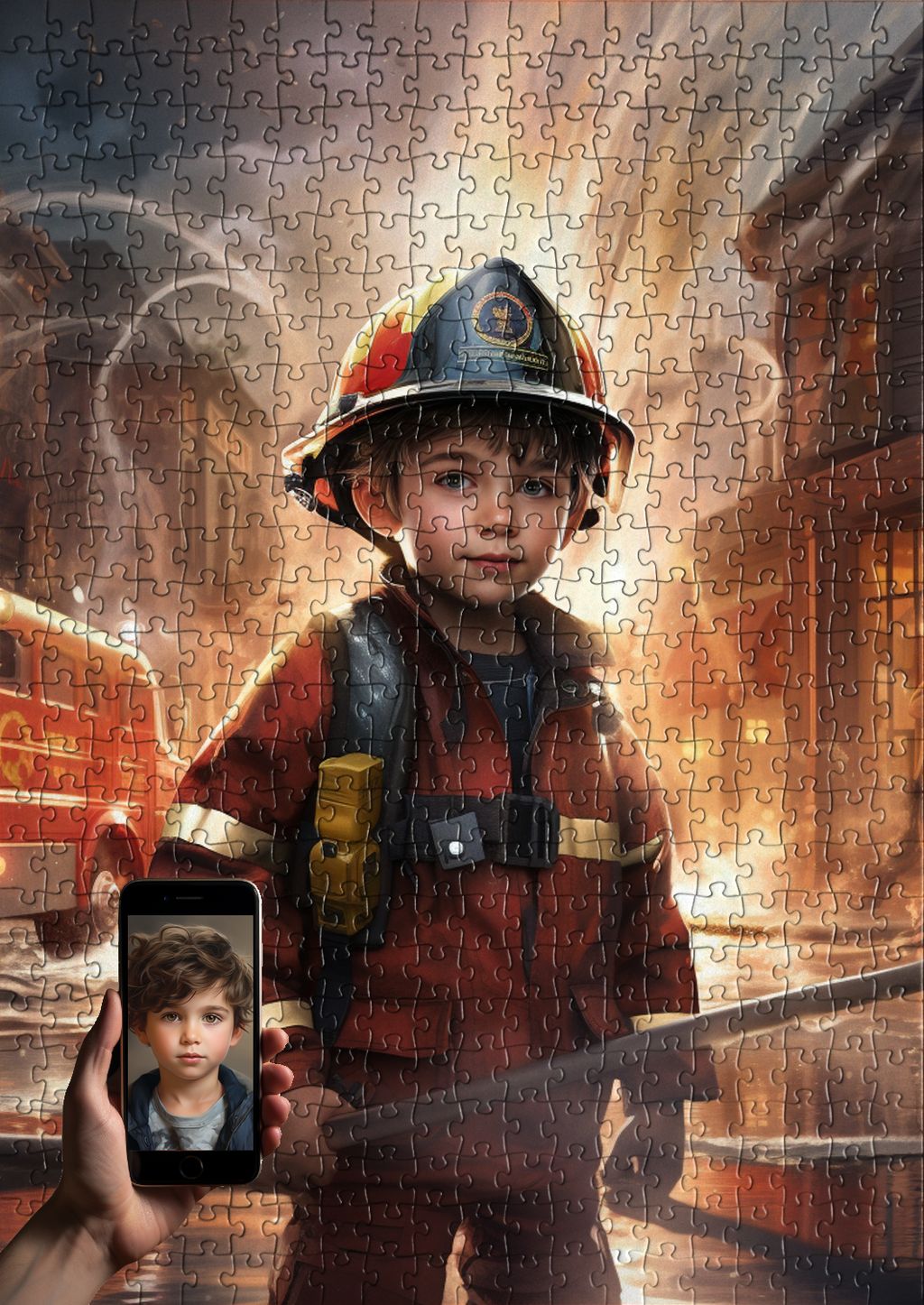
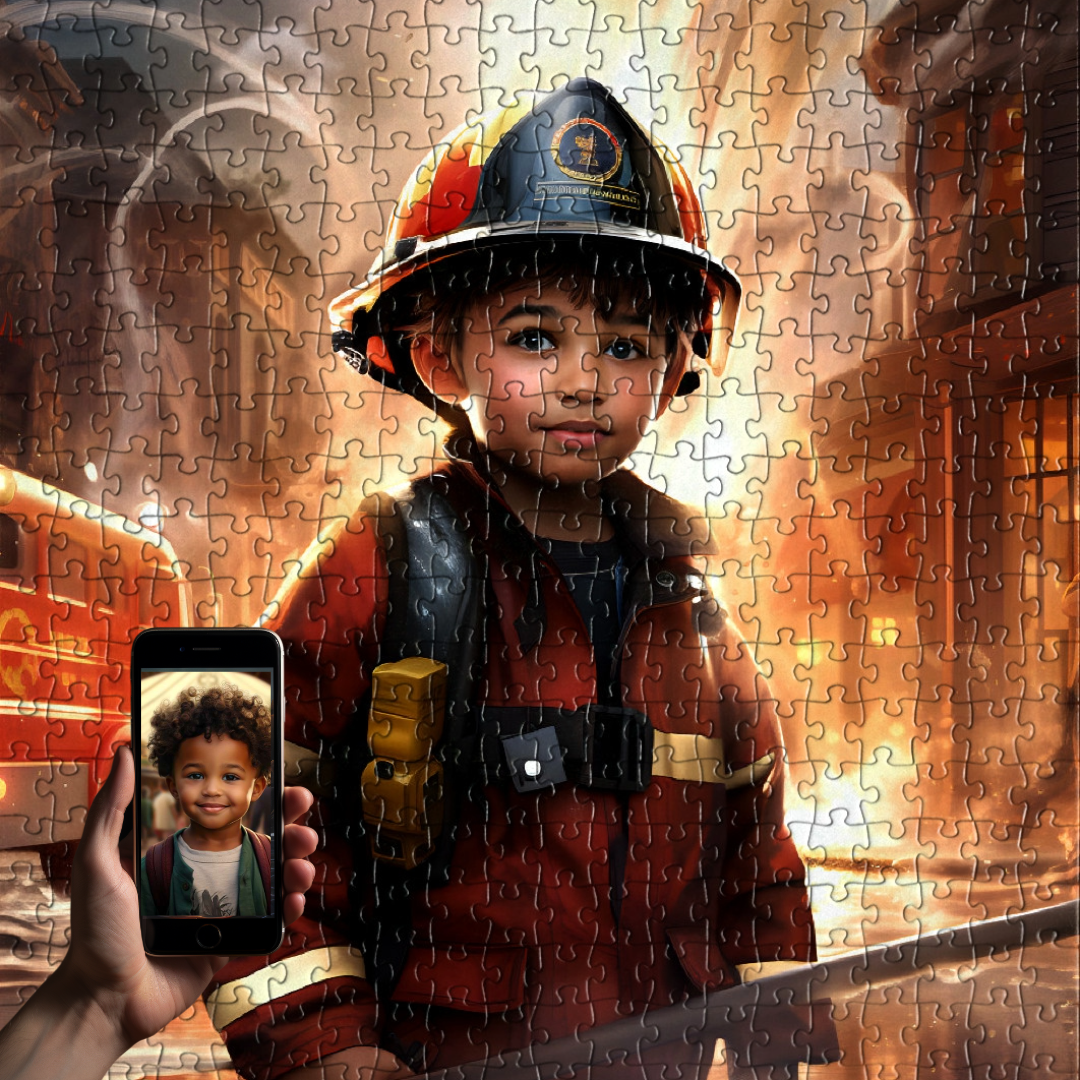
We say "anything is possible" not as marketing gloss but as an operating principle. Our existing catalogue, with options like Young Sea Adventurer and Young Civil Engineer Girl, hints at the range of worlds we have already built. But the full-custom path opens the door to whatever specific universe your child has invented in their head this month, including the ones that have never existed before and will never exist again after they outgrow them.
What "full-custom" actually means in practice
- Original scene: Not a template with a face swap. A scene composed specifically around your brief.
- Character integration: Your child (and optionally siblings, pets, or even grandparents) placed naturally into the world.
- Style flexibility: Painterly, cinematic, anime-inspired, storybook. Whatever fits the vibe of the theme.
- Iteration: Feedback rounds so that the final image actually lands, rather than being a one-shot guess.
How to Write the Perfect Order Brief
The single biggest factor in getting a custom puzzle you love is the quality of the brief you submit. The good news is that writing a great brief is not hard. It just requires being a little more specific than feels natural. Think of yourself as describing a scene to a friend over the phone who cannot see what you see. Below is a structure that consistently produces strong results.
1. Lead with the headline
Start with the one-sentence version of the theme, exactly the way your child would say it. "My son as a space-dinosaur construction foreman." This grounds everything else. Do not over-edit it. The weirder and more specific, the better.
2. Define the character role
Be clear about what your child is doing in the scene and what authority or identity they hold. Are they the hero? The captain? The discoverer? The expert? "She is the lead scientist" carries different visual weight than "she is exploring."
3. Describe the setting
Where is this happening? Underwater? On a construction site on Mars? Inside a candy factory? Give us three or four sensory details. "A glowing coral reef at dusk, with bioluminescent jellyfish drifting in the background" is dramatically more useful than "underwater."
4. Note the lighting and mood
- Golden hour: Warm, cinematic, magical.
- Twilight or moonlight: Dreamy, mysterious, calm.
- Bright daylight: Cheerful, adventurous, high-energy.
- Soft interior light: Cozy, intimate, storybook.
5. List the supporting cast
Are there sidekicks? The family dog? A specific stuffed animal? A pet dragon? Name them and describe them. If the family cat needs to appear, tell us its color and personality so it reads as that cat, not a generic one.
6. Mention the "must-haves"
These are the non-negotiable details your child will scan for the moment they see the puzzle. A red cape. A specific toy. Glasses. A particular hat. Flagging these up front prevents the heartbreak of "but where is my cape?"
7. Provide a reference photo
For face integration, a clear, well-lit, front-facing photo of your child works best. Avoid heavy shadows, hats, or angled shots. The clearer the reference, the more recognizable the result.
A sample brief that works
"My daughter Mira (age 5) as a marine biologist mermaid examining a glowing jellyfish at the bottom of the ocean. She is the lead scientist, holding a magnifying glass. The setting is a coral reef at twilight with bioluminescent plants. Lighting is dreamy, slightly purple. Her tail should be teal with gold scales. Her cat Pickles is floating beside her in a tiny brass diving helmet. Must-have: her favorite pink starfish hair clip. Style: painterly, cinematic, warm."
That brief, roughly sixty seconds to write, gives our artists everything they need to deliver something close to the vision on the first pass.
Building the Party Around the Puzzle
Once the puzzle is on its way, the rest of the party becomes startlingly easy. The puzzle has already defined the world, the palette, and the vibe. You are now just dressing the room to match.
Pull two or three colors from the puzzle
Look at the finished image and identify two or three dominant colors. Buy plain plates, napkins, and a tablecloth in those colors. You have just done ninety percent of the visual work without buying a single themed item.
Use the puzzle as the gift table centerpiece
Display the assembled puzzle (or frame it) at the heart of the gift table. Guests will gravitate to it, ask about it, and the birthday child gets to bask in being literally pictured as the hero of their own world.
Skip the licensed clutter
You do not need printed banners, character plates, or themed cups. In fact, the absence of generic licensed imagery makes the custom puzzle pop even harder. The room reads as bespoke, because it is.
Add one activity that echoes the theme
One thoughtful activity (a treasure hunt for the pirate-astronaut, a "fossil dig" for the dinosaur-engineer) beats five mediocre ones. Use the puzzle's world as your prompt.
Frequently Asked Questions
How long does a full-custom puzzle take from brief to delivery?
Production times vary, but most full-custom orders move through briefing, illustration, approval, and printing within a few weeks. If you are planning for a birthday, we recommend submitting your brief at least three to four weeks in advance to leave room for any tweaks. The earlier you start, the calmer the process feels.
What if my child's "theme" changes between ordering and the party?
It happens, and it is part of the charm of being five. The good news is that hyper-specific gifts age beautifully, even when the obsession shifts. A puzzle capturing exactly who your child was at this moment becomes a treasured artifact later, precisely because it freezes a phase that would otherwise vanish. Many parents tell us the puzzles from a "weird year" become favorites in hindsight.
Can I include siblings, pets, or grandparents in the scene?
Yes. Custom scenes can absolutely accommodate a cast of characters. Just include each person or pet in your brief, with a short description and ideally a reference photo. Group scenes work especially well for milestone birthdays or for gifts that span more than one child in the family.
Is a custom puzzle appropriate for a child who is just turning three?
Absolutely, with the right piece count. Younger children do best with larger pieces and fewer of them. When you order, choose a piece count appropriate for the age, and the experience becomes both achievable and proud-making. The image itself can be just as detailed; only the cut changes.
What if I cannot describe the scene well? I am not a writer.
You do not need to be. A short, plainspoken brief works perfectly well. If you can answer the simple questions (who, where, doing what, with whom, in what mood), our artists will handle the rest. And if anything is unclear, we will ask follow-up questions before starting. The brief is a conversation, not a test.
Closing Thoughts
The "impossible" birthday theme is not really impossible. It only feels that way when we are forced to shop in aisles built around someone else's idea of what a child should love. When you step into the role of Creative Director, armed with a single well-written sentence and the right collaborators, the universe of what your child can celebrate expands enormously. The Mermaid-Scientist gets her party. The Space-Dinosaur-Construction foreman gets his crane on Mars. And your child, whose imagination was never going to fit on a paper plate anyway, gets the rarest and most lasting gift of all: the experience of being completely, specifically, gloriously seen. That is worth a thousand themed napkins, and it lasts a great deal longer.
Share and get 15% off!
Simply share this product on one of the following social networks and you will unlock 15% off!