
You watch your child hesitate at the edge of the playground while other kids race ahead. You see them whisper an answer instead of saying it out loud, or hand a half-finished drawing back to you with a worried look, asking if it's "okay." And somewhere in the back of your mind, a quiet question starts to form: is my child lacking confidence, or is this just a phase? It's one of the most common worries parents bring up between the ages of three and six, and it's also one of the most misunderstood.
Here's the reassuring part. Confidence in young children is not a fixed personality trait. It's a skill, and like any skill, it's built slowly through experience. A four-year-old who clings to your leg at a birthday party can absolutely grow into a six-year-old who walks into a new classroom with a calm "hello." What changes isn't who they are. What changes is the collection of small, real-world experiences they've gathered, experiences that quietly whisper to them: I can do hard things. I am capable. People listen to me.
The tricky part is that confidence cannot be handed to a child through compliments. Telling a hesitant child "you're so smart" or "you can do anything" rarely lands the way we hope. Children are excellent lie detectors, and praise that doesn't match their lived experience tends to bounce off. What actually works is much quieter: giving them repeated chances to try, to struggle a little, to finish, and to notice their own progress.
This article walks through five activities to build child's confidence that genuinely help, all suitable for ages three to six. Each one includes a short rationale, a how-to, and (just as important) a "what to avoid" note, because some of the most well-meaning parental instincts can accidentally undermine the very thing we're trying to nurture. None of this requires special equipment or a parenting degree. Most of it can happen in your kitchen, your living room, or on a Saturday afternoon at the park. Let's begin.
1. Small, Achievable Challenges (Real Ones, With Real Stakes)
Confidence grows when a child completes something that actually matters to the family, not a token task invented to make them feel good. Children can tell the difference. When a three-year-old butters their own toast and serves it to a parent, or a five-year-old chooses Friday's family movie, the message they absorb is: I am a contributing member of this household. That feeling is the bedrock of confidence.
How to do it
- Let your child crack eggs into a bowl for pancakes (yes, you'll fish out shell bits, that's fine).
- Give them a real, age-appropriate kitchen tool: a small whisk, a wavy chopper for cucumbers, a butter knife for soft fruit.
- Hand over decisions that don't matter to you but matter to them: which side dish, which park, which pajamas for guests at the sleepover.
- Let them carry their own plate to the table, even if they're slow.
What to avoid
Rescuing too quickly. When the egg shell falls in, resist the urge to swoop in and "fix" it. Pause. Wait. Most of the time, your child will figure it out, and the small victory of solving the problem themselves is worth ten parental fixes. Also avoid fake choices ("would you like to put on your shoes now, or now?"). Children sense the manipulation and learn that their input isn't real.
2. Mastery Activities With Visible Progress
Young children are deeply motivated by visible evidence of their own growth. This is why Maria Montessori designed materials with what she called control of error: the activity itself shows the child whether they've done it right, without needing an adult to judge. Puzzles, building sets, simple instruments, and stacking toys all share this quality. The child can see the picture coming together, the tower getting taller, the song becoming recognizable.
This is enormously different from activities where success depends on adult approval. A puzzle either fits or it doesn't. A block tower either stands or it falls. The feedback is honest, immediate, and entirely the child's own.
How to do it
- Choose puzzles slightly above your child's current comfort level, not far above. A three-year-old comfortable with 12 pieces is often ready for 20 or 24.
- Rotate materials. Put some toys away for a few weeks and bring them back later; the "new again" effect re-engages mastery.
- Offer instruments with a clear cause and effect: a xylophone, a ukulele, a small drum.
- Keep building sets accessible on a low shelf so your child can choose them independently.
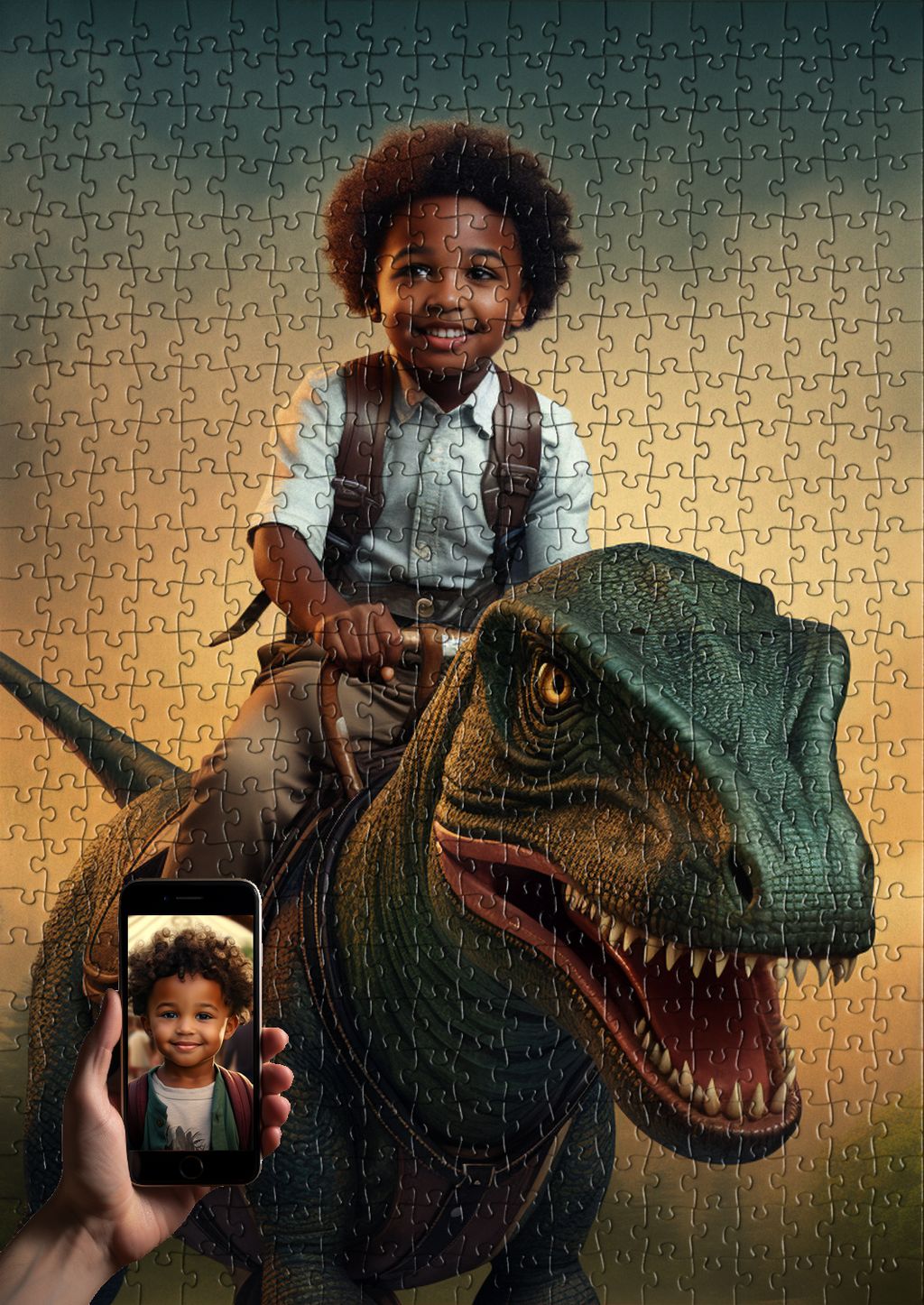
A puzzle like the Kid Riding Dinosaur works beautifully here because the imagery is engaging enough that children return to it again and again, and each completion is a quiet little win they can see and feel.
What to avoid
Over-helping. The most common parental misstep with mastery activities is sitting next to the child and gently pointing: "try that piece... no, turn it... there you go." We mean well, but we're stealing the victory. If your child is genuinely stuck and frustrated, you can offer one small clue and then back away. The struggle is the point. Also avoid praising the outcome ("what a beautiful tower!") and instead notice the process ("you kept trying even when it fell twice").
3. Storytelling Where Your Child Is the Hero
Between three and six, children are building what psychologists call a self-narrative: the internal story they tell themselves about who they are. A child who hears, sees, and imagines themselves as brave, capable, kind, and adventurous will quietly start to act that way. This isn't magical thinking, it's how identity forms at this age.
You can shape that story in everyday ways. At bedtime, tell stories where your child is the main character solving a problem. ("Once upon a time, there was a girl named Maya, and one day she found a lost puppy in the forest...") Refer back to real moments of bravery: "Remember when you tried the slide even though it looked tall? You're the kind of kid who tries things."
Make the story visible
This is also where their physical environment matters. The artwork on their walls, the books on their shelf, the puzzles they return to, all of it whispers to them about who they are. A bedroom filled with imagery of capable, adventurous children reinforces the self-narrative even when no one is talking. This is why personalized items can carry such weight at this age. When a child sees their own face on the soccer field, in a spaceship, or on the back of a dinosaur, the message lands without needing to be spoken.
Pieces like the Superhero Girl puzzle or the First Girl on the Moon work this way: the child literally pieces together a version of themselves doing something brave. For families wanting a fully bespoke story, the Unique Puzzle, Imagined by You lets you build the scene around your own child's specific passion.
What to avoid
Forcing the narrative. Don't tell a child who's clearly scared that they're "so brave!" in the moment, it reads as dismissive of their real feelings. Better to acknowledge: "That looked scary. And you did it anyway. That's something to remember." Also avoid overwriting your child's own self-description. If they say "I'm shy," don't argue. Try "sometimes you take a little time to warm up, and then you have so much to say."
4. Time With Slightly Older Peers or Cousins
One of the most underrated confidence boosters for young children is unstructured time with kids who are a year or two older, especially in family or close-friend settings where there's no competition. Younger children naturally model the behavior of slightly older children, and the gap is small enough to feel reachable. A four-year-old watching a six-year-old cousin climb a ladder thinks, "I could do that soon." A six-year-old watching a teenager doesn't think the same thing.
These mixed-age interactions also give your child a chance to be looked up to themselves when even younger children are around. Being the "big kid" who helps a toddler put on their shoes is a quiet, powerful confidence builder.
How to do it
- Prioritize gatherings with cousins, neighbors' kids, or family friends with children spanning ages 3 to 8.
- Let the older child take the lead occasionally without adult intervention.
- Resist the urge to narrate or referee every interaction. Step back.
- Mixed-age Montessori-style settings and multi-age playgroups work the same way.
What to avoid
Comparison, even subtle. Avoid "look how nicely your cousin shares" or "Sofia is already reading, isn't that great?" Children hear these as ranking, not encouragement. Also avoid hovering. The whole magic of mixed-age play is that children figure out their own social dynamics. If you're constantly nearby translating and smoothing, the dynamic resets to parent-and-child instead of kid-and-kid.
5. Letting Your Child Teach You Something
This one is small but unusually powerful. Ask your child to teach you something they know. How to draw a cat. The names of all the dinosaurs. How to put together that particular puzzle. The way to build a fort with the couch cushions. Then actually listen and follow their instructions, even if you already know.
What happens in this exchange is profound. Your child experiences themselves as the expert in a moment when they're usually the learner. They get to use grown-up language ("first you take this part, then..."), correct your mistakes, and watch you genuinely succeed because of them. Few experiences at this age build more authentic confidence than being trusted as a teacher.
How to do it
- Pick something your child genuinely knows about, even if it seems trivial (a video game character, a snack recipe, a song).
- Sit lower than them physically, if possible. It signals that they have the floor.
- Ask follow-up questions: "Wait, what do I do if it doesn't fit?" "Why does this part come first?"
- Thank them at the end. Not "good job teaching" but "I really learned something. Thank you for showing me."
What to avoid
Correcting them mid-lesson. If they call a triceratops a stegosaurus, let it go this time. The point of the exercise is the experience of being authoritative, not factual accuracy. You can revisit the correct name later in a different context. Also avoid making it feel like a performance for grandparents or guests. The teaching moment works best when it's quiet and one-on-one.
Putting It All Together: The Quiet Architecture of Confidence
If you read through those five activities, you'll notice they share a common shape. They all give the child real responsibility, honest feedback, and space to struggle. They all resist the parental urge to over-help, over-praise, or over-narrate. And they all, in different ways, tell the child a consistent story: you are someone who can do things, and the people around you trust that.
You don't need to do all five every week. Pick one or two that fit your family rhythm and let them become part of normal life. A child who cooks pancakes on Saturday, completes a new puzzle on Wednesday evening, and spends Sunday afternoon with an older cousin is quietly accumulating the exact experiences confidence is made of. Six months from now, you may notice your child speaks up at the park, or tries the climbing wall, or introduces themselves at a new class. It will look like a personality shift. It's actually the result of dozens of small wins they've collected without anyone making a big deal of it.
Frequently Asked Questions
Is my three-year-old too young to have "confidence issues"?
At three, what often looks like a confidence problem is really developmentally normal cautiousness or sensitivity. Three-year-olds are figuring out where they end and the world begins. The activities above are still helpful, but try to hold lightly to any label. Most "shy" three-year-olds simply need more warm-up time, not fixing.
How is confidence different from self-esteem?
Self-esteem is how a child feels about themselves overall. Confidence is the more specific belief that they can handle a particular situation. You build self-esteem through unconditional love and belonging. You build confidence through repeated experience of doing hard things. Both matter, and they reinforce each other.
Should I sign my child up for more group activities to build confidence?
Not necessarily. Group classes can help, but they can also overwhelm a child who's already feeling unsure. Often, one steady weekly activity with the same small group works better than three different classes. Quality and consistency beat quantity at this age.
What if my child gives up the moment something feels hard?
That's very common, and it's usually a sign they need slightly easier challenges where they can experience finishing. Drop the difficulty just a touch, let them feel the win, and inch it back up. Confidence is built on a foundation of completions, not abandoned attempts.
Does praise really hurt confidence?
Praise itself isn't harmful. Empty or inflated praise is. Saying "you're so smart" repeatedly teaches a child to fear situations where they might not look smart. Saying "you really stuck with that puzzle, even when it was tricky" teaches them that effort is what they can rely on. Specific, process-focused noticing is what helps.
Confidence isn't built in big moments. It's built in the quiet ones: the morning your child pours their own milk, the evening they finish the puzzle by themselves, the bedtime story where they're the hero. If you'd like to bring that "I am capable" feeling into their everyday space, a personalized puzzle that places your child at the center of their own adventure can be a lovely, low-key way to do it. Not because it solves anything on its own, but because it joins the long, gentle chorus of small moments telling your child the truest thing you want them to know: you can.














Share and get 15% off!
Simply share this product on one of the following social networks and you will unlock 15% off!